
BOOKS
Psychological Safety in Hybrid & Remote Teams Through Thoughtful Digital Universal Design
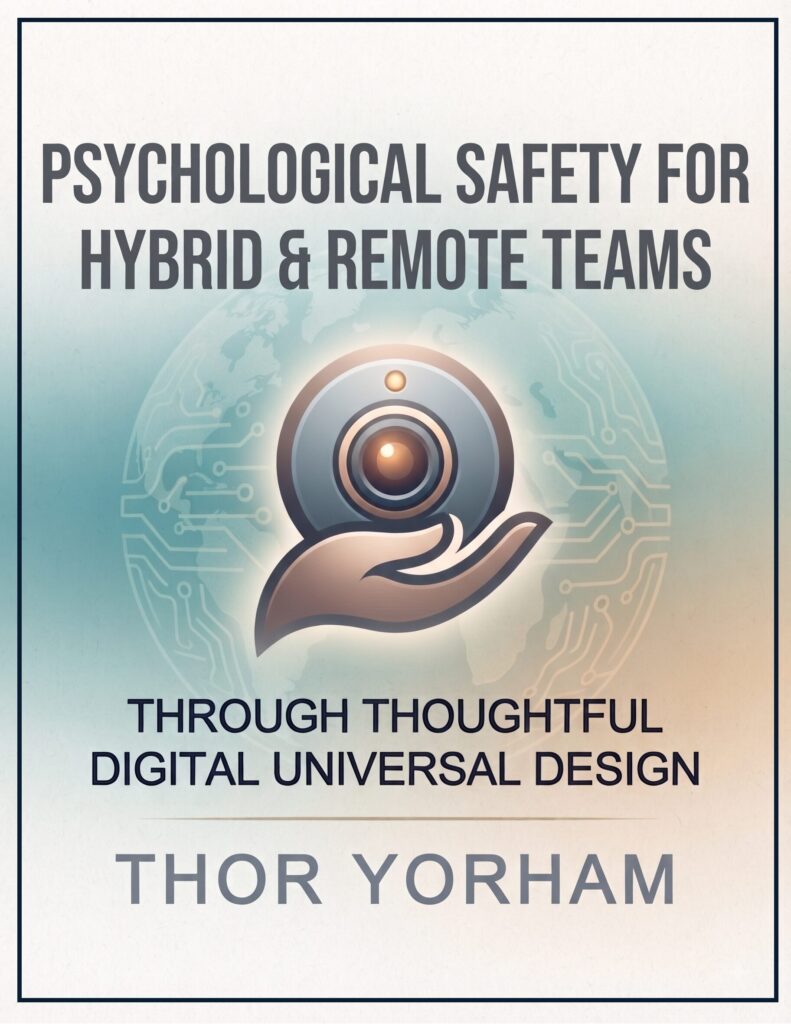
Designed for Human Resources Professionals, CEOs, Managers, and Leaders
Synopsis
Psychological Safety for Hybrid & Remote Teams Through Thoughtful Digital Universal Design provides leaders, managers, and remote professionals with actionable frameworks to eliminate digital friction, fostering environments where every team member can contribute fully. Grounded in practical methodology, it delivers clear, precise strategies for building genuine connection across distributed workspaces.
Format
Book (PDF), Color Cover, B&W Contents, 47 Pages
Instant Digital Download PDF
$19.99
TABLE OF CONTENTS
PART I: THE HIGH COST OF DIGITAL SURVEILLANCE
Introduction: When a Screen is a Wall, Not a Window
Chapter 1: The Neurobiology of Trust and the Amygdala Hijack Online
Chapter 2: The Hyper-Visibility Trap and Digital Surveillance Culture
PART II: MAPPING THE SPECTRUM OF DIGITAL MARGINALIZATION
Chapter 3: Redefining Modern Marginalization on the Grid
Chapter 4: The Physical and Cognitive Margins (Keyboard Gaps & Semantic Processing Gaps)
Chapter 5: The Relational and Socio-Cultural Margins
PART III: THE TOXICITY OF ACCIDENTAL INFRASTRUCTURE
Chapter 6: The “Just Throw Some Tools At It” Fallacy
Chapter 7: The Cognitive Tax of Masking
PART IV: ARCHITECTURE OF THOUGHTFUL DIGITAL UNIVERSAL DESIGN
Chapter 8: Pillar 1 — Radical Predictability and Boundary Engineering
Chapter 9: Pillar 2 — Equalized Contribution Matrices and Structured Anonymity
Chapter 10: Pillar 3 — Asynchronous-First Infrastructure
Chapter 11: Pillar 4 — Autonomy Defaults and Space Neutralization
PART V: THE ROI OF TRUST
Chapter 12: The Asset Multiplier Principle
Chapter 13: The Step-by-Step Corporate Re-Architecture Audit
Conclusion: Leading With Intention When the Walls Come Down
INTRODUCTION
Introduction: When a Screen is a Wall, Not a Window
When the modern workforce underwent its massive, historically unprecedented migration to remote and hybrid models, the corporate world celebrated. Press releases, executive LinkedIn posts, and white papers read like a collective manifesto of human liberation. The narrative was simple, clean, and seductive: the physical barriers of the traditional corporate office were finally being dismantled. No more grueling, hour-long commutes draining human energy before the workday even began. No more grey, windowless cubicle farms locking workers into rigid geometric boxes. No more forced visibility metrics where simply sitting at a desk until 6:00 PM counted as high performance.
For a brief moment, it looked like the ultimate democratization of the professional world. We were told that technology had built a window onto an equitable, flexible, and boundless future where the playing field was perfectly leveled. After all, on a computer screen, every person occupies a rectangle of the exact same dimensions. The intern and the CEO are visually equalized, neatly arranged side-by-side in the same grid.
But if you step away from the executive keynotes and speak privately with the people actually doing the work, a completely contradictory reality emerges. The transition to virtual spaces did not eliminate workplace barriers, it digitized them. It took the subtle biases, the toxic performance pressures, the microaggressions, and the structural exclusions of the physical office and hard-coded them directly into our software platforms. We did not escape the office politics; we simply gave them a slicker, faster, and more invasive operating system.
By shifting teams from offices onto digital screens, organizations accidentally built a culture of constant monitoring. We fell face-first into The Green Dot Illusion: the false, pervasive belief that because an employee’s status indicator is lit up green, they are connected, included, psychologically safe, and actively thriving.
The dangerous oversight where a green status dot is mistaken for team health, psychological safety, and actual productivity.
The Green Dot Illusion
The green dot tells you absolutely nothing about the human being sitting on the other side of that glass. It is a binary indicator masking a deeply nuanced crisis. Behind that tiny glowing circle, employees are quietly burning out, white-knuckling their way through intense anxiety, and spending massive amounts of daily mental energy performing “compliance” rather than focusing on actual innovation. The screen, which was promised to be a window onto radical open access, has instead become a wall, a barrier that separates leadership from the authentic daily friction their teams are experiencing.
True inclusion in remote teams isn’t something you can buy in a software package. You can’t solve a culture problem with a credit card, and you certainly can’t outsource human trust to an application. Building a healthy remote culture isn’t about tweaking a few settings. It requires rethinking how we talk to each other, how we work together, and how we measure what people actually contribute. It requires moving past technological reliance and entering the realm of Thoughtful Digital Universal Design.
I designed this book to be a strategic blueprint for leaders who are ready to stop maintaining the illusion of presence, and start building an infrastructure of authenticity, genuine empathy, and trust.
— Thor Yorham
About the Author: Thor Yorham
Thor Yorham is a resilience and radical accountability coach, keynote speaker, and disability advocate living with progressive multiple sclerosis. His signature virtual inclusion talk—Breaking the Green Dot Illusion: Psychological Safety & Inclusion in Hybrid Teams—forms the foundation of this book, helping organizations dismantle surveillance culture and build environments of genuine safety and trust.